
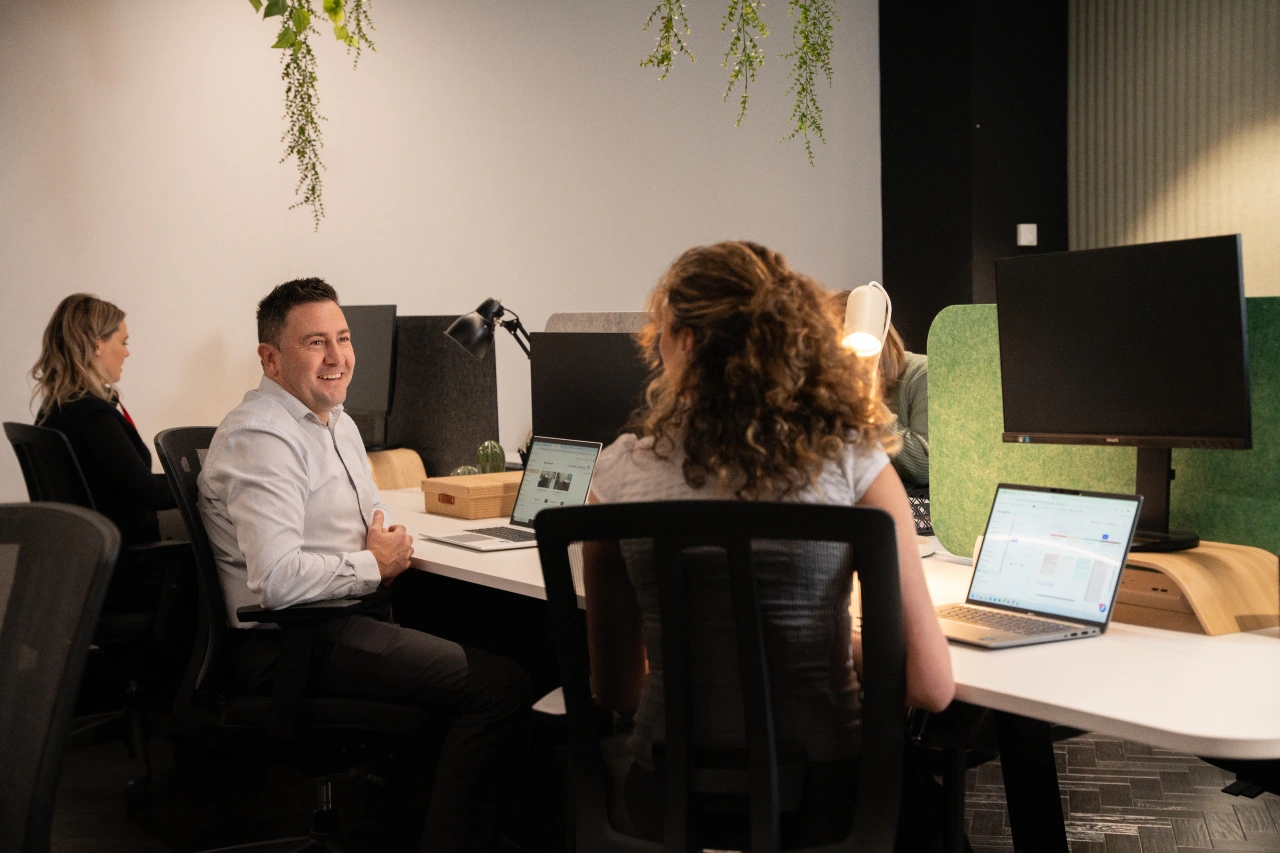

Every client interaction is shaped by more than what’s said in the room. Before a proposal is presented, before a handshake or a conversation about scope, the environment itself has already started forming an impression.
Most businesses invest carefully in how they present online — their website, their brand, their communications. Fewer think as deliberately about what their physical workspace communicates. But for clients who visit in person, the office is one of the most powerful signals available. It tells them something about how seriously you take your work, how you treat the people around you, and whether your business is the kind of operation they want to be associated with.
The impression begins before they walk in
Client perception begins to form well before anyone enters a meeting room. It starts with the address you share in an email, the building they arrive at, and the experience of getting there.
A central, professionally managed address in a well-regarded part of the city sets an immediate tone. It communicates that your business is established and intentional. Choosing a good office location itself is a foundational part of this, and worth thinking through carefully before committing to a space. Conversely, an address that’s hard to find, difficult to access, or located in an area that doesn’t align with your positioning creates a subtle disconnect — one that a client will feel.
The arrival experience matters too. Is there clear signage? Is there someone to greet them or direct them? Is the lobby or reception area well-presented? These small details are physical signs that signal operational care.
The meeting space reflects your standards
Once a client is inside, the space where you host them does a significant amount of communication on your behalf. A well-appointed meeting room — clean, quiet, properly equipped, with reliable technology — tells a client that you’ve thought about their experience, not just your own convenience.
The inverse is equally true. A room that’s cluttered or struggling with technical issues introduces friction into the meeting before business has even begun. It creates a small but real burden on the client and, at worst, shifts their focus from the conversation to the environment.
For businesses using flexible or serviced office space, access to dedicated, well-resourced meeting rooms is one of the most practical advantages. It separates the space where you host clients from the space where you do daily work, and ensures that client-facing interactions are always staged appropriately.
Professionalism is felt, not just seen
There’s a dimension of client perception that goes beyond the visual. It’s the overall feeling of a space: whether it’s calm or chaotic, whether the people in it seem focused and purposeful, whether the environment signals that this is a place where serious work happens.
Co-working and serviced office environments, when well-managed, tend to carry this quality naturally. Being surrounded by other professionals and businesses creates an ambient sense of activity and credibility that a home office or poorly occupied commercial space rarely replicates. Clients pick up on this — often without being able to name exactly what it is.
This is one reason why the community around your workspace matters, not just the workspace itself. Sharing a building with other established businesses and professionals reinforces the impression that your organisation belongs in that company.
Your space signals where your business is headed
A business operating from a premium, well-located space signals ambition and forward momentum. It suggests that the business is growing, that it takes its professional presence seriously, and that it’s worth engaging with for the long term.
This matters particularly for businesses in competitive professional services environments, where multiple providers may offer comparable capabilities. In those situations, the confidence and credibility projected by a strong physical presence can be a meaningful differentiator — one that tips a decision in your favour when the core proposition is otherwise similar.
For teams navigating hybrid arrangements, this is especially relevant: the days spent in the office need to justify themselves, for clients and staff alike.
You don’t need to own the space to benefit from it
One of the most significant shifts in modern workspaces is that access to a premium environment no longer requires ownership or a long-term commitment. A flexible membership in a well-located, professionally managed building gives businesses — regardless of their size or stage — the ability to present at a level that was previously available only to larger organisations.
For growing businesses, this levels the playing field considerably. A founder or small team operating from Haven Workspaces at 73 Northbourne Avenue has access to the same address, the same meeting rooms, and the same professional environment as a much larger organisation. From a client’s perspective, that environment speaks for itself.
Haven’s meeting rooms are designed with exactly this in mind — fully furnished, equipped for video conferencing, and available to members across all membership types, from casual access through to private offices. For businesses that host clients regularly, it’s one of the more quietly impactful investments available.
Make your environment work for you
The most effective client relationships are built on trust — and trust is built through consistency. Consistency in communication, in delivery, and in how you show up. Your physical environment is part of that consistency. It’s a dimension of your brand that operates in the background, reinforcing every other signal you’re sending.
Choosing a workspace that reflects the quality of your work isn’t a luxury. It’s a practical business decision — one that pays off in the confidence it gives clients, and in the standard it sets for everything that happens inside it.
If you’d like to see how Haven Workspaces could support how you present to clients, explore our membership options or get in touch with the team.